3 Best Educational Stories for Kids – Fun Tales with Powerful Life Lessons
Updated: 07 May, 2026
54
Free read 3 Best Educational Stories for Kids. Every parent and teacher knows that children learn best through stories. A well-crafted tale can teach honesty, kindness, perseverance, and empathy far more effectively than a lecture ever could.
These 3 best Educational stories for kids combine imagination with moral lessons, helping young minds develop strong character while keeping them engaged.
Whether you are looking for bedtime stories, classroom read-alouds, or short moral tales for children, this handpicked collection of the best educational stories for kids covers timeless themes — honesty, hard work, friendship, courage, and kindness — that children aged 3 to 10 will love and remember.
Why Educational Stories Are Important for Children’s Development
Before diving into the stories, it is worth understanding why storytelling matters so much in early childhood education.
Research in child psychology shows that stories help children build vocabulary, improve listening comprehension, develop empathy, and understand cause-and-effect relationships. When kids follow a character through a problem and a solution, they internalize the lesson naturally — without feeling “taught.”
Short moral stories for kids are also ideal for sparking conversations between parents and children about values like respect, responsibility, and kindness.
Story 1: The Kind Elephant — A Lesson in Friendship and Empathy
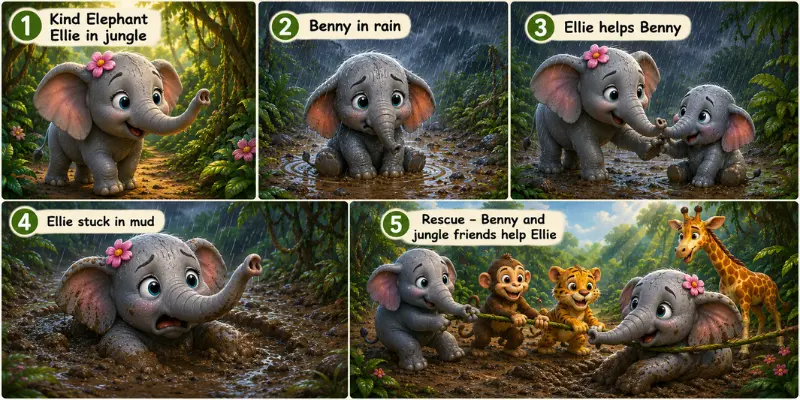
Age Range: 3–7 years | Core Value: Kindness and Friendship
Deep in a colorful jungle lived a large, gentle elephant named Ellie. All the animals knew her because she always had a kind word and a warm smile for everyone.
One rainy morning, Ellie was walking through the jungle when she saw a small rabbit named Benny sitting under a leaf, shaking with cold. His burrow had flooded, and he had nowhere to sleep.
Without hesitating, Ellie used her big trunk to carefully clear a dry spot under an enormous tree. She gathered large leaves to make a soft bed for Benny and shared her own food with him.
“Thank you, Ellie,” Benny whispered, his eyes wide with gratitude. “Why are you so kind to me? We barely know each other.”
Ellie smiled warmly. “You needed help, and I was able to give it. That is the only reason I need.”
Weeks later, Ellie got her foot stuck in thick mud near the riverbank. She struggled and pulled but could not get free.
Benny saw her and hopped into the village, calling every animal he could find. Together — a deer, a monkey, a parrot, and Benny — they worked as a team, pulling and tugging until Ellie was free at last.
“You came back for me,” Ellie said, tears in her eyes.
“Of course,” said Benny. “Friends always do.”
Lesson for Kids
Kindness is never wasted. When you help others without expecting anything in return, the world becomes a warmer and more connected place — and friendship grows in the most unexpected ways.
Top 5 Short Moral Stories on Honesty for Kids in English
Story 2: The Little Star Who Was Afraid of the Dark — A Lesson in Courage
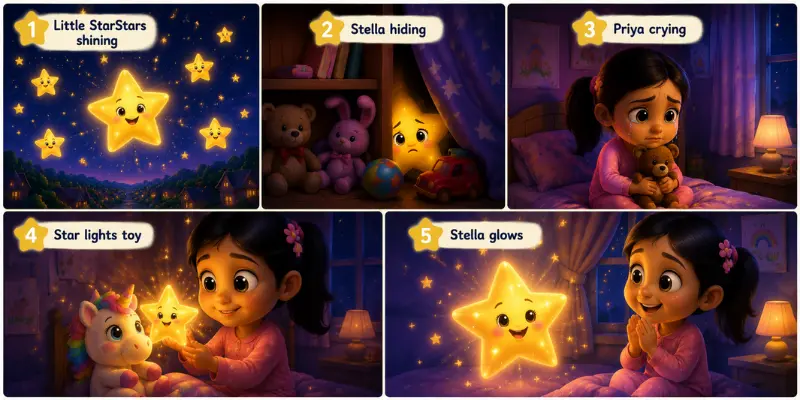
Age Range: 3–6 years | Core Value: Courage and Self-Belief
High up in the night sky lived hundreds of glowing stars. Each night, they would shine as brightly as they could to light up the world below.
All except one — a tiny star named Stella.
Stella was afraid. She worried that she was too small, too dim, and that no one would notice her light. Every night, while the other stars spread their glow across the sky, Stella hid behind a cloud, watching.
One night, a little girl named Priya sat in her garden below, crying softly. She had dropped her favorite toy in the garden and could not find it in the dark.
Stella peeked out from behind her cloud. She saw the child’s tears and felt something warm stir inside her heart.
“What if my light isn’t bright enough?” she wondered. Then she thought, “But what if it is just enough?”
Taking a deep breath, Stella pushed past her cloud and shone with everything she had. Her gentle glow fell exactly on Priya’s lost toy, sitting between two flower pots.
“I found it!” Priya cried happily, looking up. “Thank you, little star!”
Stella glowed warmer and brighter than she ever had before. She realized that her light — small as it was — had been enough all along.
Lesson for Kids
Courage is not the absence of fear. It is choosing to shine anyway. Every child has a unique gift, and the world needs each one of them to be brave enough to share it.
Story 3: The Two Brothers and the Magic Well — A Lesson in Gratitude and Generosity
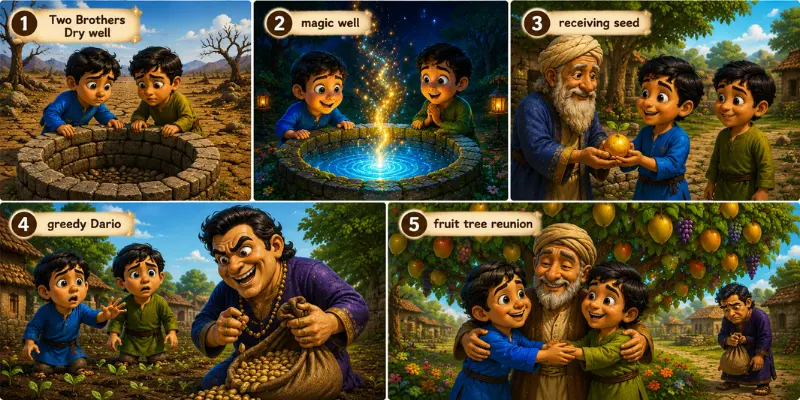
Age Range: 5–10 years | Core Value: Gratitude, Generosity, and Consequences
In a small village at the edge of a great forest, two brothers lived side by side. Rami was kind, curious, and thankful for everything he had. His brother Dario was greedy and always wanted more.
One summer, the village well ran dry. Rami walked deep into the forest to search for water and came upon a shimmering well surrounded by wildflowers.
A tiny old woman sat beside it. “You may drink,” she said, “but take only what you need.”
Rami thanked her, filled one small jar, and offered to carry her basket back to the forest edge before he left. She smiled and handed him a single seed. “Plant this at home,” she said.
He did. Overnight, a beautiful fruit tree grew in his garden — one that fed his family and his neighbors all through winter.
When Dario heard the story, he rushed to the forest. He found the same well and the same old woman.
“Give me water,” he demanded, filling jar after jar. When she offered him a single seed, he said, “A seed? That is nothing!” and tossed it away.
He returned home with heavy jars — but by morning, every drop had turned to dust.
Dario ran back to the forest, but the well and the old woman were gone.
That evening, Rami shared his fruit with his brother, asking for nothing in return. Dario sat quietly, and for the first time, understood what he had been missing.
Lesson for Kids
Gratitude opens doors that greed closes. True richness comes not from how much we take, but from how freely and joyfully we give.
Tips for Reading Educational Stories with Your Child
Getting the most out of story time takes just a little effort. Here are some simple strategies that parents and teachers use to make every tale more impactful:
- Read aloud with expression. Use different voices for characters. Children engage more deeply when the story feels alive.
- Ask questions during the story. “Why do you think Leo lied?” or “What would you have done if you were Ellie?” These questions build critical thinking skills and emotional intelligence.
- Connect stories to real life. After reading, share a time you were honest or helped a friend. Real-life connections help children apply lessons to their own experiences.
- Let children retell the story. Retelling boosts comprehension and memory. Ask your child to tell the story back to you in their own words.
- Read regularly. The American Academy of Pediatrics recommends reading aloud to children from birth and continuing well into the early school years. Consistency builds a lifelong love of reading.
Conclusion
The best educational stories for kids do more than entertain — they shape character, build empathy, and plant the seeds of lifelong values. From the honesty lesson in The Boy Who Cried Wolf to the courage of little Stella and the generosity of Rami, each story in this collection offers a powerful takeaway wrapped in warmth and imagination.
Share these stories at bedtime, in the classroom, or on a lazy afternoon — and watch your child grow not just as a reader, but as a thoughtful, kind, and courageous human being.
FAQs About Educational Stories for Kids
| FAQs About Educational Stories for Kids |
|---|
What age group benefits most from educational stories? Children aged 3 to 10 benefit greatly, as this is a critical window for character development, language growth, and moral understanding. How often should I read educational stories to my child? Daily reading, even for just 10–15 minutes, significantly boosts literacy, vocabulary, and emotional development. Are fables and moral stories different from educational stories? Fables are a type of educational story, typically featuring animals with a stated moral. Educational stories are broader and can include any tale designed to teach values or life skills. Can educational stories help children with anxiety or fear? Yes. Stories like The Little Star Who Was Afraid of the Dark normalize fear and show children that courage is possible, making them powerful tools for emotional support. What makes a good educational story for kids? A good educational story has relatable characters, a clear problem and solution, a simple but meaningful moral, and age-appropriate language that holds a child’s attention. Do educational stories improve academic performance? Research shows that regular story reading improves comprehension, vocabulary, and focus — all of which support academic performance across subjects. |
Please Write Your Comments