The Emperor’s New Clothes – Hans Christian’s Classic Fairy Tales
Updated: 10 May, 2026
86
A timeless fairy tale about vanity, truth, and the courage it takes to speak up — even when everyone else stays silent.
Few fairy tales have outlasted their era quite like The Emperor’s New Clothes. Written by Danish author Hans Christian Andersen and first published on 7 April 1837, this short but powerful story has been translated into over 100 languages and adapted for television, theatre, and film across the globe. It has given the world a lasting idiom — “the emperor has no clothes” — used whenever an obvious truth goes deliberately unspoken.
What makes the tale so enduring? At its core, it exposes the very human tendency to conform, to stay silent, and to choose the comfort of a shared lie over the discomfort of an honest word. Politicians, business leaders, and educators reference it constantly. Whether you are reading it for the first time or revisiting it as a teacher, parent, or curious adult, this guide walks you through the full story, its moral, its themes, its history, and its classroom potential.
⚡ Quick Facts About The Emperor’s New Clothes
- Author: Hans Christian Andersen
- First Published: 7 April 1837, Copenhagen, Denmark
- Publisher: C. A. Reitzel (alongside The Little Mermaid)
- Original Language: Danish — Kejserens nye klæder
- Genre: Literary fairy tale, satirical fable
- Reading Age: 5+ (story); 10+ (full themes)
- Translations: 100+ languages
The Emperor’s New Clothes — Full Story
A Fashion-Obsessed Emperor
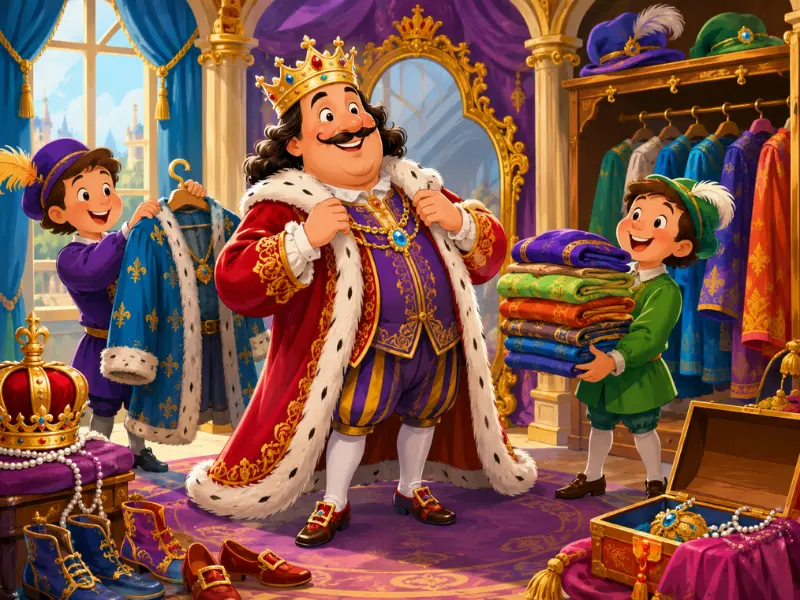
Many years ago, there lived an Emperor who cared about nothing in the world except the clothes on his back. He did not think about his army, his people, or the affairs of state. He thought only about what he would wear next. He had a different outfit for every hour of the day. Where other rulers might be described as sitting in council, people said of this Emperor: “He is in his dressing room.”
His grand capital city was always lively. Merchants, travellers, and dignitaries arrived daily seeking trade and favour. And it was on one such ordinary day that two strangers rode into town — strangers who would turn the entire kingdom upside down.
Two Swindlers Arrive
The two men were swindlers, though they presented themselves as master weavers of extraordinary skill. They spread the word that they could create the most magnificent fabric ever seen — cloth of breathtaking colour and intricate pattern. But the cloth had a special, magical property: it was completely invisible to anyone who was unfit for their position, or who was foolish beyond remedy.
“Imagine,” they said with gleaming eyes, “a fabric that reveals the incompetent and the stupid.” The Emperor’s ears pricked up immediately. Here was a cloth that could do the work of a spy — it would help him identify which of his ministers was truly worthy. He summoned the swindlers and commissioned a full suit at once, paying them a generous sum in advance.
The Work Begins — Or Seems To
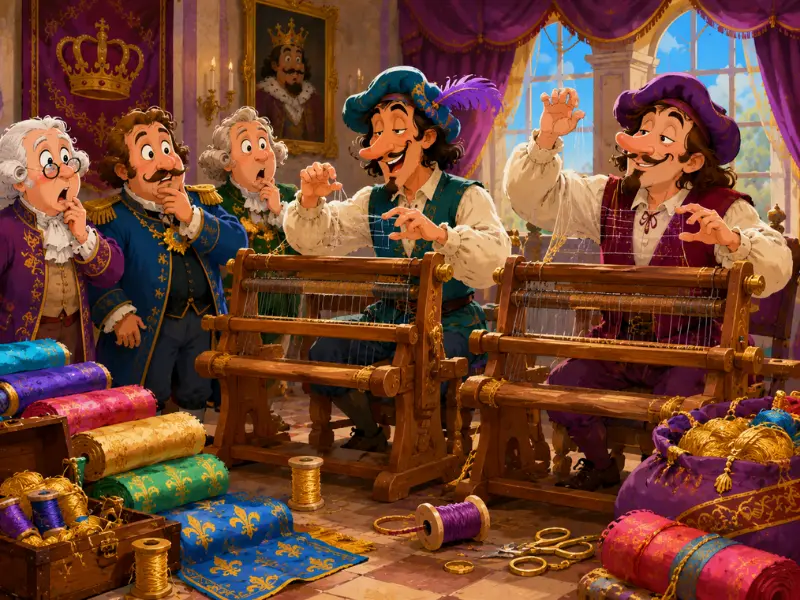
The two men set up their looms in a grand chamber, called for the finest silk and the purest gold thread, and pocketed everything. They worked through the night at empty looms, moving their hands through the air, cutting with scissors that snipped nothing, and sewing with needles that held no thread. Anyone who looked closely could see there was nothing there at all. But who would dare say so?
The Emperor Sends His Minister
Curious but also nervous, the Emperor sent his most trusted old minister to inspect the progress. The minister walked in, looked at the empty looms, and felt his blood run cold. I cannot see a thing, he thought. Does this mean I am a fool? Unfit for office? The thought was unbearable. So instead of telling the truth, the minister nodded slowly and said, “Oh, it is beautiful and enchanting! The colours and the patterns are quite extraordinary. I will tell His Majesty.”
He returned to the Emperor and praised the invisible cloth in glowing terms.
Another Visit, Another Lie
A second official was sent, and the same thing happened. He saw nothing, feared the worst about himself, and left singing the cloth’s praises. News spread through the court and then through the city: the Emperor’s new suit was the most magnificent thing anyone had ever, or rather, never seen.
The Emperor Sees for Himself
Finally, the Emperor went to see the cloth with his own eyes. He stood before the loom and stared. There was nothing. His heart hammered. Can it be that I am stupid? That I am not fit to be Emperor? The idea was horrifying. So he smiled broadly, tilted his head as if admiring the weave, and declared it superb. Every nobleman around him did the same. The swindlers were awarded medals and given the grand title of Gentleman Weavers.
The Parade Begins
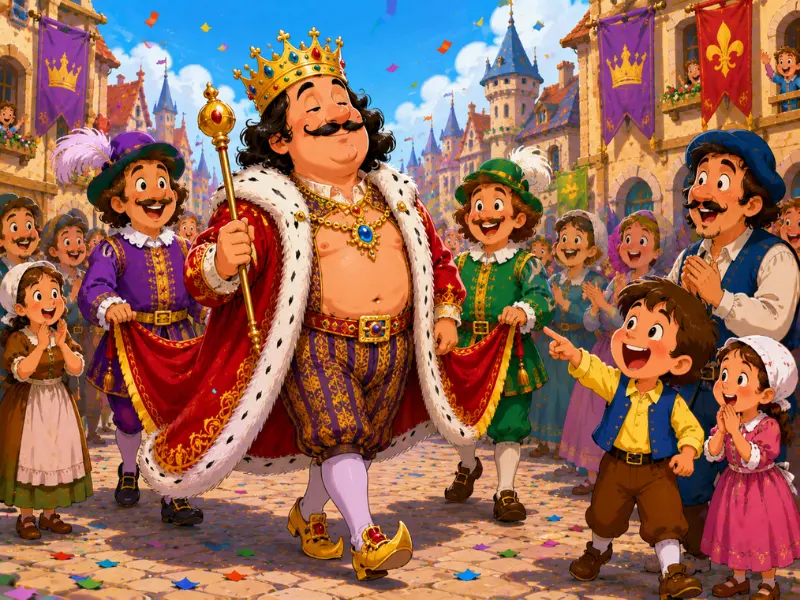
The day of the grand procession arrived. The swindlers mimed the act of dressing the Emperor — lifting trousers, fastening an invisible coat, arranging an invisible mantle. They told him the clothes were so light he would feel as though he wore nothing at all. Noblemen bent to lift a train that did not exist. The Emperor walked out into the street, stark naked, holding himself with the greatest dignity he could muster.
The crowd lining the route had heard about the magical cloth. Nobody wanted to be seen as a fool. So every man, woman, and merchant cheered and cried out how splendid the suit looked. The lie hung in the air, shared by the entire city.
A Child Speaks the Truth
Then, a small child — too young to understand the stakes, too innocent to fear judgment pointed and called out in a clear, carrying voice:
“But he hasn’t got anything on!”
The father hushed the child in embarrassment. But the words had escaped. One person whispered to another. The whisper grew. Soon, the whole crowd was murmuring: “He has nothing on! The child is right!” The laughter and the truth spread like wildfire through the streets.
The Emperor heard it. A shudder ran through him, for he knew they were right. But he squared his shoulders, lifted his chin, and walked on more proudly than before. The chamberlains followed behind, still pretending to hold up the train that was never there.
Story Summary
A vain emperor obsessed with fine clothing is tricked by two swindlers posing as master weavers. They claim their fabric is invisible to anyone foolish or unfit for office. Afraid to appear stupid, every official who inspects the empty looms pretends to see magnificent cloth.
The emperor himself does the same. During a public parade in his “new clothes,” a child blurts out the obvious truth — the emperor is naked. The crowd finally agrees, but the emperor, too proud to admit he was conned, continues the procession anyway.
More Fairy Tales
| A child cries out, “He has nothing on!” | Detail |
|---|---|
| Setting | A child cries out, “He has nothing on!” |
| Conflict | Vanity and fear of judgment vs. the simple truth |
| Climax | A child cries out “He has nothing on!” |
| Resolution | The truth spreads — but the emperor keeps walking |
| Tone | Comic, satirical, sharply observational |
| Point of View | Third-person omniscient |
Characters in The Emperor’s New Clothes
| Character | Role | What They Represent |
|---|---|---|
| The Emperor | Protagonist and victim | Vanity, pride, self-deception |
| The Two Swindlers | Antagonists | Manipulation, exploitation of ego |
| The Old Minister | First inspector | Fear of judgment, careerism |
| The Second Official | Second inspector | Social conformity, groupthink |
| The Courtiers | Supporting cast | Collective dishonesty, peer pressure |
| The Child | Truth-teller | Innocence, courage, honesty |
| The Crowd | Society at large | Social conformity, mob mentality |
What Is the Moral of The Emperor’s New Clothes?
The story delivers several interlocking moral lessons, each relevant to readers of every age:
1. Vanity Blinds Us to Reality
The emperor’s obsession with appearance makes him an easy target. He wants so badly to be seen as clever and well-dressed that he refuses to acknowledge what his own eyes or rather, his lack of eyes on anything, tell him. When pride becomes our primary filter, we stop seeing the world as it actually is.
2. Fear of Judgment Silences Truth
Every adult in the kingdom, from the most senior minister to the humblest street dweller, stays quiet because they fear being labelled a fool. This is the danger of groupthink: when everyone assumes everyone else can see the cloth, nobody dares be the first to say otherwise. The result is a shared, collective lie.
3. Honesty Takes Courage
The child who speaks up is not brave in any dramatic sense; they simply have not yet learned the social rules that silence adults. But the effect is the same as true courage: the truth gets out. Andersen’s message is that honesty, however uncomfortable, is always more powerful than a comfortable lie.
4. Question Authority
The story warns against blind deference to powerful people. Simply because the emperor declares the clothes magnificent does not make them real. Evidence that can be directly observed — or in this case, not observed at all should always override what authority figures claim.
💡 The Modern Relevance
The phrase “the emperor has no clothes” is used daily in politics, business, journalism, and academia to describe any situation where an obvious falsehood persists because nobody is willing to be the first to challenge it. From corporate boardrooms to social media echo chambers, the dynamic Andersen described in 1837 plays out every single day.
Themes & Symbolism
| Theme | How It Appears in the Story |
|---|---|
| Vanity & Pride | The emperor spends his entire treasury on clothes; he cannot admit he has been fooled. |
| Social Conformity | Every citizen pretends to see the cloth because they fear social exclusion. |
| Truth vs. Illusion | The “clothes” are entirely imaginary, yet everyone treats them as real. |
| Innocence of Childhood | Only the child, unaffected by social pressure, speaks the plainly visible truth. |
| Political Satire | A ruler distracted by appearance neglects his actual duties, a warning to all leaders. |
| Groupthink | Each individual’s fear reinforces the next person’s silence, creating a shared delusion. |
| Power of Language | One child’s words shatter an illusion maintained by an entire kingdom. |
Symbolism: What Do the “Clothes” Represent?
The invisible clothes are one of the most brilliant symbols in all of fairy tale literature. They stand for any belief, policy, or narrative that people collectively pretend to accept out of social pressure or self-interest. The clothes are real because everyone agrees they are real until one voice refuses to agree. In this way, Andersen anticipated modern concepts like social construction of reality and pluralistic ignorance, ideas that psychologists and sociologists would not formally name for another century.
History & Origins of The Emperor’s New Clothes
Andersen did not invent this story from scratch. His tale is rooted in a 14th-century Spanish collection of cautionary tales called the Libro de los ejemplos (also known as El Conde Lucanor), compiled around 1335 by Juan Manuel, Prince of Villena. In the original Spanish tale, the magical fabric was invisible to any man who was not the biological son of his presumed father a story about illegitimacy rather than incompetence.
Andersen encountered the story through a German translation and fundamentally transformed it. He shifted the moral focus from questions of parentage to questions of intellectual vanity and courtly pride a far more universal human failing. He also added the most important change of all: the ending. In his first draft, no one questions the emperor’s clothes at all. Just before sending the manuscript to the printer, Andersen had a flash of inspiration and inserted the child, whose single line of honesty gives the story its enduring power.
Published alongside:The Little Mermaid, both appeared in the same 1837 collection, making 7 April 1837 one of the most remarkable single days in the history of children’s literature.
Vocabulary Spotlight
Use these key words to deepen understanding of the story’s language and its broader relevance:
Swindler: A person who deceives others for personal gain; a con artist.
Vanity: Excessive pride in one’s appearance or achievements; self-admiration.
Conformity: Behaviour that follows the expectations or norms of a group, even against one’s own judgement.
Groupthink occurs when a group suppresses individual doubts to maintain harmony or avoid conflict.
Procession: A formal ceremonial march or parade, often of dignitaries.
Satire: The use of humour or exaggeration to expose and criticise people’s foolishness or vices.
Allegory: A story whose characters and events carry a deeper symbolic meaning beyond the literal plot.
Dramatic irony: When the audience knows something characters in the story do not — here, the reader knows the cloth is fake from the start.
Classroom Activities
These discussion-based and creative activities are suitable for primary and secondary students studying the story in an English, PSHE, or Drama setting.
Truth and Pressure Chart
Students list moments where characters could have told the truth but didn’t, and identify what stopped them. Map responses on a class chart.
Freeze Frame Drama
Groups recreate key scenes as frozen tableaux — the minister’s inspection, the parade, the child’s outburst. Discuss what each character might be thinking.
Missing Thought Bubbles
Students write the internal monologue of the minister, the child’s father, and the emperor during the parade. Compare honesty of thought vs. words spoken.
Newspaper Report
Write a front-page news report as a royal correspondent covering the parade. Must include quotes from eyewitnesses — some honest, some not.
Design the “Invisible” Outfit
Students design what the outfit would look like if it were real, using the swindlers’ description. Label materials and write a designer’s note.
Debate: Who Is Most to Blame?
Structured class debate: is the emperor, the ministers, the crowd, or the swindlers most responsible for the deception? Each group argues its case.
Modern Link Task
Students find a real-world example of “the emperor has no clothes” — in politics, advertising, or social media — and present their findings.
Writing Prompts
Continue the story: what happens the next morning? Or retell it from the child’s perspective. Alternatively, write a modern retelling set in a school or office.
Frequently Asked Questions
Who wrote The Emperor’s New Clothes?
It was written by Danish author Hans Christian Andersen and first published in 1837 alongside The Little Mermaid.
When was The Emperor’s New Clothes first published?
The story was first published on 7 April 1837 by C. A. Reitzel in Copenhagen, Denmark.
What is the main moral of The Emperor’s New Clothes?
The primary moral is that vanity and fear of social judgment can prevent people from speaking the truth and that honesty, even from the most unlikely source, is more powerful than a shared lie.
Why does only a child speak the truth?
The child has not yet learned the social rules that silence adults. Andersen uses childhood innocence to show that truth requires no expertise only the willingness to say what we actually see.
Is The Emperor’s New Clothes based on an older story?
Yes, Andersen adapted it from a 14th-century Spanish tale in El Conde Lucanor, transforming the moral focus from questions of parentage to vanity and intellectual pride.
What does “the emperor has no clothes” mean as an idiom?
It describes any situation where an obvious truth goes unspoken because people are afraid to challenge a powerful person, popular idea, or shared belief.
How many languages has the story been translated into?
The story has been translated into over 100 languages, making it one of the most widely read fairy tales in the world.
What grade level is The Emperor’s New Clothes suitable for?
The basic story works from age 5 upwards; the satirical themes and deeper moral discussions are best explored from around age 9–10 and beyond.
Did Andersen originally include the child in the story?
No — the child was added at the last moment, just before the manuscript went to print. It was an inspired late change that made the story’s moral far more powerful.
What themes does The Emperor’s New Clothes explore?
Key themes include vanity, social conformity, groupthink, truth versus illusion, the innocence of childhood, and political satire.
Conclusion
The Emperor’s New Clothes has survived nearly two centuries not because it is a comfortable story, but because it is an uncomfortable one. It holds up a mirror to behaviour most of us recognise — in ourselves and in the world around us. We have all, at some point, been the minister who said nothing, or the courtier who nodded along. The child’s shout is a reminder that truth does not require rank, age, or authority. It only requires the willingness to say what we actually see.
Hans Christian Andersen gave us a story that is, at once, a children’s fairy tale and a sophisticated piece of social satire. It belongs in classrooms, in bedrooms at story time, and in any conversation about courage, conformity, and the power of a single honest voice. The emperor may have walked on proudly through that street. But the child’s words — and Andersen’s story — have never stopped echoing.
🪡 “The Emperor’s New Clothes” by Hans Christian Andersen · First Published 1837 · Public Domain
Please Write Your Comments