The Tinderbox by Hans Christian Andersen Fairy Tale
Updated: 25 May, 2026
24
Let’s enjoy a retelling of The Tinderbox fairy tale, which was originally written by Hans Christian Andersen. Published on 8 May 1835, The Tinderbox (Fyrtøjet in Danish) was the very first fairy tale Hans Christian Andersen released to the world.
More than 190 years later, it still captivates readers young and old with its fast-moving plot, darkly comic tone, and surprisingly complex hero.
If you are exploring this classic story for school, homeschooling, or sheer pleasure. It is a perfect retelling of a famous fairy tale
- Two tiers: 12–15 min (retelling) and 20–25 min (original text), more useful for teachers choosing versions
- Reworded to “Readers who enjoy…” feels like a recommendation, not a tag
- Added the parenthetical (authored, not anonymous folk tale), a key distinction that adds expertise
- Split into two separate rows, Core Themes and Moral, giving each the space it deserves
- Specific, memorable moral: “Fortune favours the quick-witted, but power without conscience carries a cost.” far more quotable and distinctive
- Added “Upper Elementary / Middle School (Grades 4–6)”, matching both UK and US educator terminology
What Is The Tinderbox? A Quick Overview
The Tinderbox is a literary fairy tale written by Danish author Hans Christian Andersen. Unlike folk tales passed down anonymously through generations, this is an authored story shaped deliberately by Andersen’s voice, wit, and worldview.
| Feature | Details |
|---|---|
| Original Title | Fyrtøjet (Danish) |
| Published | 8 May 1835 |
| Collection | Tales, Told for Children (Booklet 1) |
| Genre | Literary fairy tale |
| Setting | Denmark (implied: Copenhagen and surrounding countryside) |
| Aarne-Thompson Tale Type | AT-562 — The Spirit in the Blue Light |
The story follows a returning soldier who strikes a deal with a witch, discovers a magical tinderbox, summons three extraordinary dogs, falls in love with a locked-away princess, loses and regains his fortune, and ultimately becomes king not through virtue, but through cunning and luck.
The Story of The Tinderbox Fairy Tale
The Soldier Meets the Witch
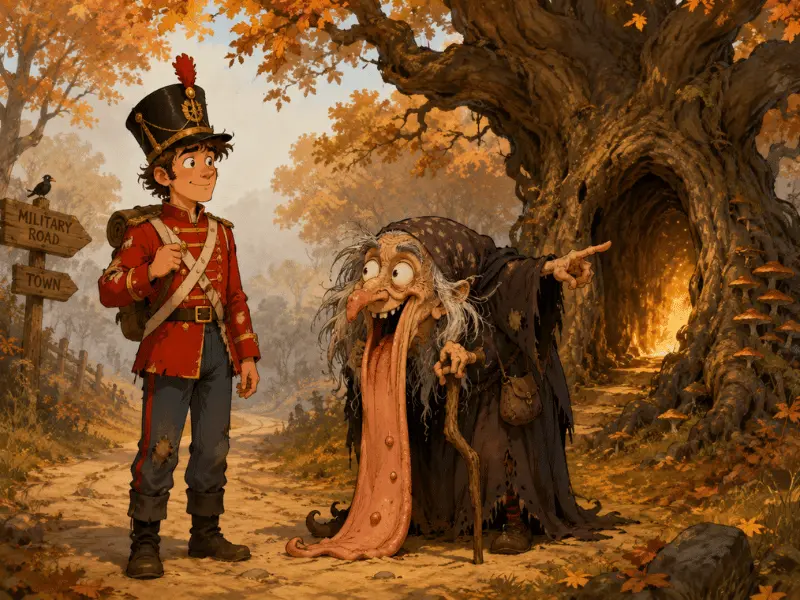
Long ago, a soldier was returning home after many years of fighting in a war. His boots were dusty from the long road, and all he carried with him was his sword, a small knapsack, and the hope of finding a better life. Though he had served bravely, he was poor and had nowhere to go.
As he walked through a lonely forest road one evening, he suddenly met a strange and frightening old witch. She was ugly and bent with age, and her lower lip hung all the way down to her chest. Her eyes gleamed sharply as if she knew many secrets.
“Good evening, soldier,” the witch croaked. “You have a fine sword and a strong body. I can make you richer than you ever dreamed.”
The soldier stopped at once. He had never owned much money, so the offer caught his attention.
The witch pointed toward a large hollow tree nearby. The trunk was split open, and deep inside was a hidden passage leading underground.
“If you climb down into that tree,” she explained, “you will find three rooms filled with treasure. In each room sits a huge dog guarding a chest of coins. Bring me only one thing, an old tinderbox I left there many years ago, and all the treasure can be yours.”
The soldier listened carefully. Although the witch looked terrifying, the thought of treasure was too tempting to ignore.
The Rooms of Copper, Silver and Gold
Before the soldier climbed down, the witch handed him her blue-checked apron.
“You must place each dog on this apron,” she said. “Then they will not harm you.”
The soldier tied a rope around his waist, and the witch lowered him into the hollow tree. Down and down he went until his feet touched the floor of a dark underground chamber.
Ahead of him stood a heavy wooden door. He opened it carefully and gasped in amazement.
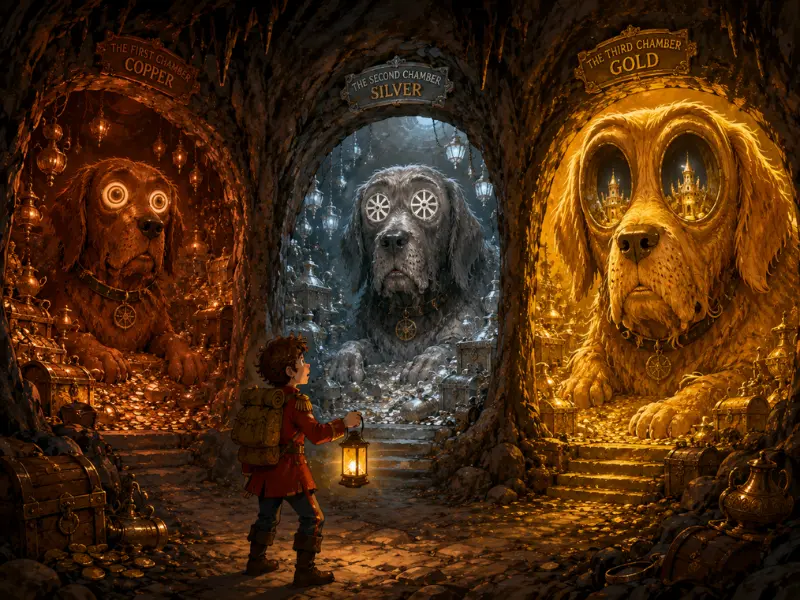
Inside sat a monstrous dog with eyes as large as teacups. The creature stared at him without blinking while guarding a huge chest filled with copper coins.
Remembering the witch’s instructions, the soldier quickly spread the apron on the floor and lifted the dog onto it. The beast sat quietly while the soldier filled his pockets with copper.
Then he entered the second chamber. There sat another dog, even larger than the first, with eyes as big as spinning mill wheels. Behind it stood a chest overflowing with silver coins. Again, the soldier placed the dog on the apron and stuffed his bag with silver.
Finally, he opened the third door.
At once, he stepped backwards in shock.
The dog inside was enormous, and its eyes were as large as the famous Round Tower of Copenhagen. The beast looked terrifying, but the soldier bravely placed it on the apron just like the others.
Behind the dog stood a chest overflowing with shining gold coins. Gold glittered everywhere in the candlelight. The soldier’s eyes widened with excitement. He emptied out the copper and silver to make room for as much gold as he could carry. He filled his pockets, boots, knapsack, and even his hat until he could barely walk from the weight.
Before leaving, he remembered the witch’s request and picked up the old tinderbox lying in the corner.
Then he called for the rope, and the witch pulled him back to the surface.
The Witch Asks for Her Price
When the soldier climbed out of the tree, the witch eagerly stretched out her hand.
“Give me the tinderbox,” she demanded.
The soldier handed over nothing yet. He noticed how desperate the witch seemed and grew suspicious.
“Why is this old tinderbox so important?” he asked.
“That is none of your business,” the witch snapped angrily. “Just give it to me!”
Her refusal made the soldier believe the tinderbox must hold some secret value. He became cautious and stubborn.
“No,” he said firmly. “Tell me the truth first.”
But the witch only screamed louder and demanded the tinderbox again and again.
The soldier’s temper rose. In a sudden burst of anger and fear, he drew his sword and struck the witch dead.
For a moment, the forest fell completely silent.
The soldier stood breathing heavily beside the old witch’s body. Then he wrapped the tinderbox safely inside his knapsack, gathered his gold, and walked away.
It is one of the darkest moments in the tale — shocking, sudden, and morally unsettling. Yet the story continues without apology, as many old fairy tales often do.
A Fine Life in the City
Now rich beyond imagination, the soldier travelled to a grand city filled with busy streets, tall buildings, and fashionable people. He rented beautiful rooms at the finest inn and bought expensive clothes made of velvet and silk.
People who once ignored him now treated him with respect. He attended dinners, visited theatres, and made many new friends. Everyone admired his wealth and generous spending.
The soldier enjoyed his new life greatly. He gave coins freely to beggars, tipped servants generously, and spent his evenings dining and celebrating.
During this time, he heard stories about the kingdom’s beautiful princess. People said she lived inside a great copper castle surrounded by walls and towers. Her parents kept her locked away because a prophecy had foretold that she would marry a common soldier someday.
The soldier became curious about the princess, though no one in the city had ever truly seen her.
From Riches to Rags
Although the soldier had once possessed mountains of gold, he spent carelessly and thoughtlessly. Day after day he wasted money on luxury, entertainment, and fine living.
Eventually, every last coin disappeared.
The grand friends who had once surrounded him suddenly vanished as well. No one invited him to parties anymore. No one visited him.
Forced out of his expensive rooms, the soldier moved into a tiny attic chamber under the roof of an old building. His clothes became worn, and sometimes he went hungry.
One cold evening, he sat alone in the dark with no candle to light the room. Searching through his belongings, he found the old tinderbox and struck it to create a spark.
Instantly, the room shook.
To his amazement, the dog with teacup-sized eyes suddenly appeared before him.
“What is your command, master?” the creature asked.
The soldier stared in disbelief. At last he understood the true power of the tinderbox.
The Princess in the Night
Excited by his discovery, the soldier commanded the dog to bring him the princess.
Without hesitation, the magical dog raced through the city, entered the copper castle, lifted the sleeping princess gently into its arms, and carried her through the night air to the soldier’s attic room.
The princess remained asleep the entire time.
The soldier looked upon her beauty with wonder. He kissed her softly, then ordered the dog to return her safely before dawn.
The next morning, the princess told her parents she had experienced a strange dream about a soldier carrying her away during the night.
The king and queen became alarmed.
Still, the soldier could not resist using the tinderbox again. On the second night, he ordered the dog to fetch the princess once more. Again, she visited him while asleep and remembered only strange dreams the next day.
The queen decided to uncover the truth.
On the third night, she secretly followed behind as the magical dog carried the princess through the streets. The queen cleverly carried a small bag filled with grain and poked a hole in it, allowing seeds to scatter along the path like a trail.
At last, the trail ended at the soldier’s attic room.
Flour on the Castle Floor
The royal family now knew exactly who had taken the princess.
But the queen wanted stronger proof before acting. A clever lady-in-waiting came up with another plan. She tied a small bag of flour to the princess’s back while she slept. Tiny holes in the bag allowed flour to sprinkle onto the floors and streets wherever the princess travelled.
That night, when the magical dog carried the princess away once again, a clear white trail marked the entire journey.
In the morning, the flour trail led directly to the soldier’s room.
The guards immediately arrested him and threw him into prison.
The dark prison cell smelled of damp stone and iron. The soldier realised too late that his magical adventures had brought him into terrible danger.
The Gallows Beyond the Gate
Soon the judges sentenced the soldier to death by hanging.
News of the execution spread throughout the city. Crowds gathered outside the gates to watch the hanging, while the king and queen sat proudly nearby, believing justice would finally be served.
On the morning of his execution, the soldier looked sadly through the bars of his prison window. By chance, he saw a young shoemaker’s boy running past.
The soldier quickly called out to him.
“If you fetch my tinderbox from my attic room,” he whispered, “I will give you four gold coins.”
The boy eagerly agreed and hurried away.
A little later, just as the soldier stood beneath the gallows with the noose around his neck, the shoemaker’s boy returned secretly and handed him the tinderbox.
The soldier asked permission to smoke one final pipe before dying. The judges allowed it.
Instead, he struck the tinderbox once.
Then twice.
Then three times.
In an instant, all three enormous dogs appeared before the horrified crowd.
The dogs attacked with terrifying force. They seized the judges, councillors, king, and queen, tossing them high into the air until they crashed to the ground. Panic swept through the crowd as people screamed and fled in every direction.
Then suddenly the people began shouting together:
“The soldier shall be our king!”
The princess was freed from the copper castle, and she gladly married the soldier. The three magical dogs sat proudly beside them at the wedding feast, their enormous eyes shining brightly as the celebrations continued long into the night.
Characters in The Tinderbox
- The Soldier: The protagonist. Bold, quick-witted, and resourceful, but also morally ambiguous. He kills without hesitation, spends without restraint, and pursues the princess in ways the story never questions.
- The Witch: The catalyst. She holds the secret of the tinderbox but hides her motives. Many readers see her as a gatekeeper between the ordinary world and the magical underworld.
- The Three Dogs: Supernatural servants tied to the tinderbox. Each guard greater treasure and represents growing magical power.
- The Princess: Largely passive in the plot but central to the soldier’s motivation. Her liberation from the copper castle is framed as the story’s triumph.
- The King and Queen: Authority figures and obstacles. Their fate, thrown into the air by magic dogs, reflects Andersen’s quietly subversive view of power.
Key Themes in The Tinderbox
1. Power, Luck, and Fortune
The soldier does not earn his throne through good deeds. He stumbles into power through chance encounters, a magic object, and fast thinking under pressure. Andersen presents fortune as random and fickle; the same gold that buys friends disappears just as easily, leaving the soldier alone.
2. Greed and Its Consequences
Both the soldier and the witch are driven by desire; she for the tinderbox’s power, he for gold and status. The witch pays with her life. The soldier loses everything before the tinderbox saves him. Andersen embeds a quiet warning: greed without wisdom is unstable.
3. Social Class and Mobility
The tale reflects the rigid class structure of 19th-century Europe. A common soldier cannot legally court a princess. The prophecy and the tinderbox together are the only tools that can shatter that barrier. Andersen, who grew up poor and spent his life navigating Denmark’s social hierarchies, understood this tension personally.
4. Morally Imperfect Heroes
This is perhaps the story’s most modern quality. The soldier is not as good as Cinderella, nor is Snow White. He is cunning, self-interested, and sometimes cruel. Yet readers root for him. Andersen resists the easy comfort of a morally spotless hero, making the tale feel raw and honest in a way many fairy tales do not.
The Moral of The Tinderbox
The Tinderbox deliberately resists a single clean moral. Some scholars argue that there is no moral; the story reflects a cynical view of society where money buys friendship and power trumps justice.
Others read it differently:
- Fortune favours the resourceful: The soldier survives not because he is good, but because he thinks quickly.
- True values outlast wealth: The soldier’s gold disappears, but his courage and wit remain.
- Power without conscience is dangerous: The soldier wins, but his victory leaves a trail of bodies and broken rules behind him.
The most honest reading is probably this: The Tinderbox holds a mirror up to human nature without flinching. It shows us a hero we might recognise, imperfect, ambitious, and lucky, and asks us to sit with the discomfort of cheering for someone who has not necessarily earned it.
The Tinderbox and Aladdin: Connections and Differences
Andersen was a devoted reader of One Thousand and One Nights as a young man, and the parallels between The Tinderbox and Aladdin and the Wonderful Lamp are impossible to miss.
| Element | The Tinderbox | Aladdin |
|---|---|---|
| Magic object | Tinderbox (fire-starter) | Oil lamp |
| Supernatural helper | Three enormous dogs | Genie |
| Underground chambers | Three rooms with treasure | Cave of wonders |
| Antagonist | The witch | The sorcerer |
| Sleeping princess | Brought to the hero by night | Visited by the hero |
| Social rise | Soldier becomes king | Poor boy becomes prince |
Where Aladdin is ultimately rewarded for good character (and repents his mistakes), the soldier in The Tinderbox faces no such redemption arc. Andersen’s version is faster, darker, and more morally untidy, which is precisely what makes it feel so distinctly his.
About Hans Christian Andersen
Hans Christian Andersen was born on 2 April 1805 in Odense, Denmark, into a poor family. His father was a shoemaker; his mother, a washerwoman. Despite a difficult childhood, he moved to Copenhagen as a teenager, eventually earning support from the Danish Royal Theatre and a government stipend to attend school.
He published his first collection of fairy tales, which included The Tinderbox, The Princess and the Pea, and Little Claus and Big Claus in May 1835. Danish critics initially dismissed his informal, chatty style. Readers, however, loved it immediately, and his stories spread across Europe within a few years.
Andersen went on to write more than 150 fairy tales and stories, including The Little Mermaid, The Ugly Duckling, Thumbelina, The Snow Queen, and The Emperor’s New Clothes. He died on 4 August 1875, by which time he was celebrated worldwide as one of the greatest storytellers who ever lived.
Vocabulary Spotlight
Understanding key words deepens appreciation of the story:
| Word | Meaning in Context |
|---|---|
| Tinderbox | A small metal box holding flint, steel, and tinder used to start fires before matches existed |
| Knapsack | A soldier’s backpack for carrying belongings |
| Copper / Silver / Gold | The three metals represent ascending levels of wealth in the underground chambers |
| Flint | A hard stone that produces sparks when struck — the key mechanism of the tinderbox |
| Prophecy | A prediction about the future; here, that the princess will marry a common soldier |
| Gallows | The wooden structure used for hanging as a form of execution |
Classroom Activities and Discussion Ideas
Discussion Questions for Students
- Is the soldier a hero? What makes someone a hero in a fairy tale compared to real life?
- Why do you think the witch wanted the tinderbox so badly? What do you imagine she planned to do with it?
- The soldier’s friends disappear when his money runs out. What does this say about friendship and wealth?
- Is the ending a happy one? Who wins and who loses?
- Compare The Tinderbox with Aladdin. Which character do you prefer, and why?
Classroom Activities
- Story Map: Chart the main events from the road to the gallows, identifying the turning points.
- Character Judgment Chart: Assess each character’s choices — were they brave, selfish, wise, or unfair?
- Creative Writing: Rewrite the ending from the princess’s point of view.
- Compare Two Tales: Place The Tinderbox alongside The Emperor’s New Clothes and discuss what each says about power.
Conclusion
The Tinderbox by Hans Christian Andersen is far more than a children’s fairy tale. It is a sharp, funny, and morally complex story about luck, desire, power, and the unpredictable way fortune moves through human lives. Its soldier-hero is flawed in ways that feel modern and honest. Its ending is triumphant but uneasy. And its magic three dogs with spinning-plate eyes, a little metal box that controls fate, remains as vivid today as it was when Andersen first put pen to paper in 1835.
Whether you are reading it aloud to a child, studying it for class, or returning to it as an adult, The Tinderbox rewards attention. There is always something new to notice, a dark joke, a quiet irony, or a truth about human nature hiding just beneath the fairy-tale surface.
FAQs – The Tinderbox fairy tale
What is The Tinderbox by Hans Christian Andersen about?
It tells the story of a soldier who discovers a magical tinderbox that summons three powerful dogs, uses it to win a princess, and ultimately becomes king.
When was The Tinderbox first published?
It was published on 8 May 1835 as part of Andersen’s debut collection, Tales, Told for Children.
What is the moral of The Tinderbox?
The story has no single clear moral; it explores themes of luck, greed, and power, suggesting that fortune is fickle and that resourcefulness matters more than virtue.
Is The Tinderbox based on an older story?
Yes — Andersen drew on a Danish folk tale called The Spirit in the Candle and shares similarities with Aladdin and the Wonderful Lamp from One Thousand and One Nights.
Why does the soldier kill the witch?
She refuses to tell him why she wants the tinderbox, so he kills her and keeps it. Andersen presents this without moral comment, which is part of what makes the tale so unusual.
What do the three dogs in The Tinderbox represent?
They represent ascending magical power and serve as supernatural helpers — a common element across world folklore. Each guards a greater treasure and answers to the power of the tinderbox.
Is The Tinderbox suitable for young children?
It contains violence and morally complex themes, making it more appropriate for older children (ages 8 and up) with adult-guided discussion.
What type of fairy tale is The Tinderbox?
It is a literary fairy tale (authored, not anonymous) classified under the Aarne-Thompson tale type AT-562, known as The Spirit in the Blue Light.
How is The Tinderbox different from other Andersen stories?
Unlike tales such as The Little Mermaid or The Red Shoes, which carry clear emotional or moral weight, The Tinderbox is faster, more irreverent, and deliberately avoids rewarding or punishing the hero in a morally tidy way.
What happened to the tinderbox at the end of the story?
The story does not say. The soldier becomes king, and the tinderbox his source of power throughout, fades quietly from the narrative, as if power, once taken, needs no further explanation.
Please Write Your Comments